GALESBURG HISTORY
This story is part of an occasional Galesburg Community News series exploring local history.
The bones of St. Crescent have rested in Galesburg for nearly 140 years, and his name is legend in the city. He has long been said to protect Galesburg from tornadoes.
But how did he get here — and who was the man who brought him?
That story begins not with a storm, but with a priest.
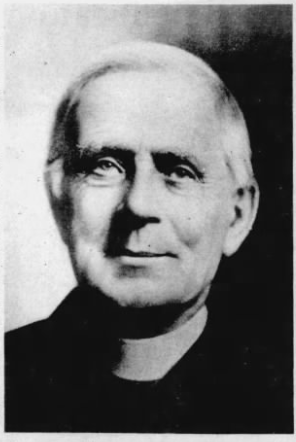
On Oct. 6, 1887, the Rev. Father Joseph Costa stepped off a train in Galesburg, returning from a three-month trip to Italy, the land of his birth and the heart of the Catholic Church. He was weeks away from turning 64 and had been serving the Galesburg community since 1877.
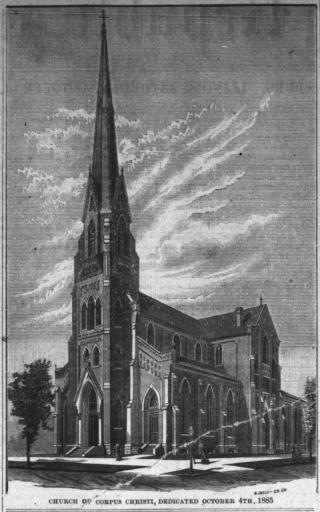
In that decade, he had already laid a foundation for generations of Catholics in the city, founding St. Joseph’s Academy at Academy and Knox streets in 1878 and Corpus Christi Church at Prairie and South streets in 1885.
Costa was born in 1823 in northern Italy, not far from Turin, the son of a tailor. At 21, he chose the priesthood. After years of study in Italy and England, he was ordained Feb. 19, 1853, in Birmingham, England.
He came to the United States in 1864, traveling during the Civil War to begin his American service in Springfield. He was there when President Abraham Lincoln was assassinated and led Catholic mourning in the city.
After serving in Jacksonville, Bloomington and Lincoln, Costa was sent to Galesburg in 1877, when the town’s population was about 10,000 and St. Patrick’s Church on South Academy Street served the city’s Catholics.
He quickly got to work.
The cornerstone for St. Joseph’s Academy was laid in 1878, and the school opened the following year with 295 students, led by 14 nuns from the Sisters of Providence of St. Mary-of-the-Woods, Indiana.
“The construction of the academy brought a boom to the neighborhood,” Norma Cunningham wrote in 1972 upon the school’s closing. “Houses were built for Catholic families so children would be close to school, and family grocery stores moved into the area.”
Costa’s work also brought tension.
In September 1879, the death of a 7-year-old boy led to a confrontation that turned violent weeks later. According to a letter Costa wrote, the boy’s father — angered after a dispute over religious matters — came to his door.
“Seeing that he was trying to pick a quarrel, I opened the door so that he might leave peacefully,” Costa wrote.
“But he seized me by the neck and struck me with an iron with such force as to leave me for dead, and took to his heels.”
Costa suffered a suspected skull fracture. The man was arrested and charged with attempted murder but later acquitted after a jury deliberated for 12 hours.
Costa saw the attack as part of broader tensions in the community, writing that opposition to the new Catholic school and his efforts, including a temperance society, had stirred resentment.
Despite that, he continued building.
As Galesburg’s Catholic population grew, St. Patrick’s became too small. A new site at Prairie and South streets was secured, and in 1884 the cornerstone was laid for Corpus Christi Church. The church, dedicated in 1885, cost about $35,000 (about $1.1 million in 2025).
“The church itself is a sermon,” Costa said at its dedication, “proclaiming to all that they have souls to be saved.”
It was after this work was underway that Costa returned from Italy with something that would outlast even the buildings he constructed.
According to tradition, St. Crescent was a child about 10 years old who was executed during the reign of Roman Emperor Diocletian around the year 300, during a period of persecution of Christians. His remains were buried in the catacombs of Rome until 1838.
During his 1887 trip, Costa obtained permission to bring the relic to Galesburg.
The Galesburg Republican-Register described the journey that followed:
“It being enclosed in a case of thin glass, yet it traveled through the railroads of Italy, France, England and from New York to Galesburg without the least injury … Yet it reached Galesburg in a state of perfection.”
Before leaving, Costa had expressed concern about transporting it safely. He was told, according to the account, that “Saint Crescent will take care of himself and him too.”
From there, the story begins to shift from history into legend.
One version holds that Costa had planned to sail to America on the Alesia but changed his mind at the last moment. The ship later ran into disaster, reinforcing the belief that the relic had protected him — and, by extension, the city he served.
But contemporary reporting suggests a different story.
According to the Republican-Register, Costa wanted to take that route but was unable to do so. Records show the Alesia was stricken with cholera, resulting in multiple deaths before reaching New York, where it was quarantined.
Costa’s own journey was not without danger.
In the mid-Atlantic, the ship carrying him suffered a major mechanical failure, drifting while temporary repairs were made. The engine failed again before the vessel ultimately reached Newfoundland. It was believed that a severe storm could have doomed the ship.
Perhaps this — rather than later retellings — is where the idea of protection took hold.
With St. Crescent placed within Corpus Christi Church — where the relic remains today — Costa continued his work in Galesburg.
He purchased land for St. Joseph’s Cemetery in 1891 and oversaw the construction of the Corpus Christi Lyceum, a boys’ high school that opened in 1895. In 1909, he secured two nuns from Peoria to establish a hospital, first housed in a 12-room building near the Knox County Courthouse before a larger facility opened in 1914.
By then, Costa had retired.
On Feb. 19, 1903, the city marked the 50th anniversary of his priesthood.
“I feel like a man at the end of a long journey,” he said. “Though I have worked for fifty years it seems but yesterday that I was ordained.”
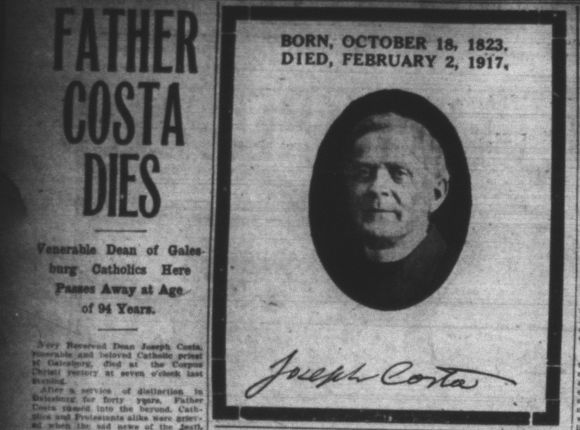
The Rev. Father Joseph Costa died Feb. 2, 1917, at age 94.
“In his death Galesburg loses one of its Christian pioneers and one of its most public-spirited citizens,” the Galesburg Evening Mail wrote.
“He grew into the affections of the people without regard to denomination,” the Republican-Register added.
Costa lay in state at Corpus Christi Church — the church he built — before being buried at St. Joseph’s Cemetery, the cemetery he founded.
The legend he helped bring to Galesburg, however, did not end with his death.
Through decades of retelling, the story of St. Crescent has grown into something larger than its origins — a belief, for some, that the presence of a child saint has shielded the city from tornadoes, even as surrounding communities have not been spared.
Whether rooted in fact, coincidence or faith, the story endures.
And it begins with the man who carried it here.