At 92, Harley Knosher reflects on four decades at Knox College.
According to an old saying, people may forget what you said, but they’ll never forget how you made them feel.
For thousands of athletes and students over four decades at Knox College, Harley Knosher managed to do both.
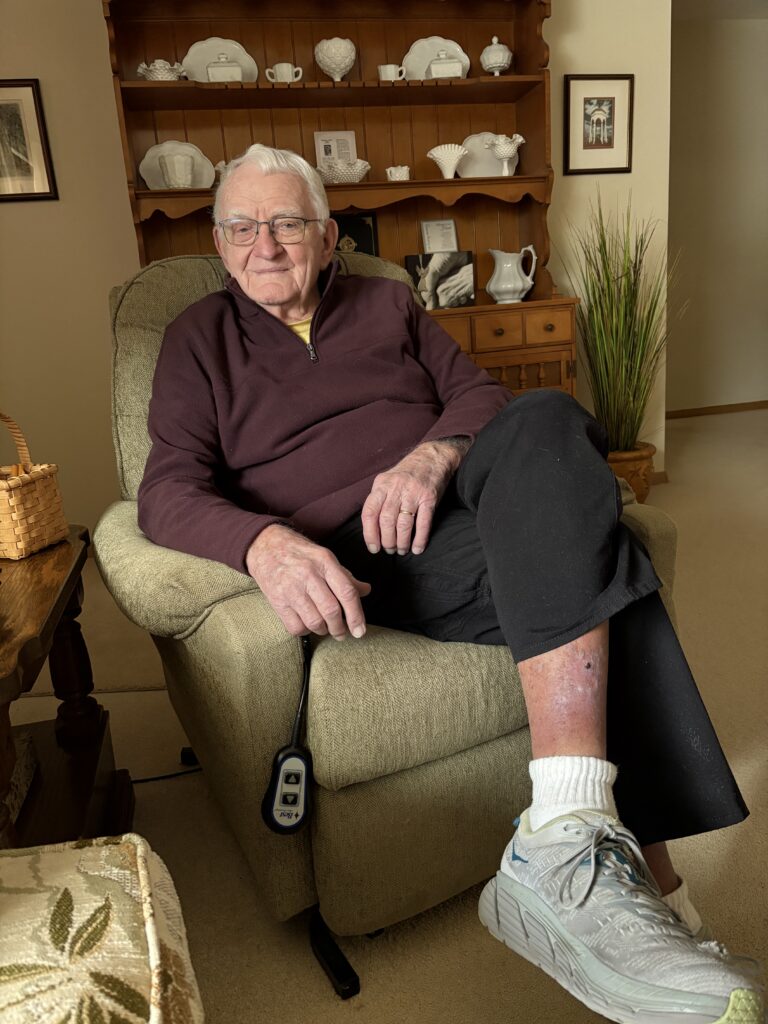
Knosher’s 40-year career at the Galesburg school ended in 2000, but his presence remains woven into its athletic history. Now 92 — he turned 92 on Feb. 3 — the retired coach and athletic director still radiates the kind, honest, enthusiastic, soft-spoken presence he did on campus.
At a recent social function near Chicago, a conversation between a Knox alum and a Galesburg resident began with a simple question: “Is Harley Knosher still around?”
Assured that he was, the alum immediately shared a memory.
Nearly everyone who has met Knosher seems to carry one.
Knosher grew up in Naperville, Ill., and graduated from Miami University in Ohio, where he played basketball. Knosher credits much of his ability to connect with people to his college coach, Bill Rohr.
“My biggest influence was my college coach Bill Rohr,” he said. “He fills such a dominant role I don’t know who else to compare it to.
“It was just his approach to everything.”
Knosher said Rohr taught him an important concept: “You don’t have to like all your players, but you have to love all your players.”
Another mentor he quickly credits is his mother. “She always said I know you, I love you, I want to do something for you.”
“As I’ve gotten older and smarter, I try to apply it to every person that I deal with,” he added, “because that’s the bedrock of my philosophy.”
After playing at Miami and serving as an assistant for Rohr at Northwestern University, Knosher considered taking the head basketball job at Knox in 1960 as a possible stepping stone to something bigger.
Fate intervened.
“My first couple of years at Knox we were 10-34 or something, so the opportunities weren’t there,” he said. “But I realized that I had the opportunity to work with some wonderful young people without money moving into the equation.
“When I think of all Knox College has done for my life, it’s unreal.”
In those early years, Knox had just four coaches covering all sports. Knosher coached football, basketball, baseball and golf. Women’s programs had yet to be established, and athletic facilities were modest compared with today’s campus.
As a football assistant under Al Partin, he helped steady the program through difficult seasons before its resurgence in the 1970s and ’80s, producing players such as NFL standout Robert Prout and future NFL head coach Todd Monken.
As head basketball coach through 1984, his teams compiled a 254-280 record, highlighted by memorable victories — especially against archrival Monmouth. His five years as baseball coach included a 15-4 season.
But Knosher says golf may have brought him the most joy. One of his first moves as athletic director was to fire himself as baseball coach and hire himself as golf coach.
“I got to play with my players during practice,” he said. “It’s a game I love.”
The success followed. Knox won nine consecutive Midwest Conference golf championships and 15 of 16 during the 1980s and ’90s.
Despite his mild-mannered image off the court, his competitive edge surfaced on the sidelines.
“I made a lot of fuss on the sidelines,” he recalls. “But I had very little problem with officials. I went into a game assuming the officials would disappoint you and they will, but you just go on from there.”
What made him angry?
“If an opponent is trying to do harm to my players or if an opponent is cheating or if my players don’t do what they’re supposed to do,” he said.
The rivalry with Monmouth became legendary and, at times, bitter.
“It never softened when I was there. I think it softened after I left.
“From the outside people were saying it was bad,” he continued. “I was part of it and I can’t call it bad.”
Long before youth sports camps became commonplace, Knosher helped bring one of the first to the Knox campus.
In partnership with the Milwaukee Bucks from 1970 to 1990, the college hosted about 500 players annually — from grade school through high school — for a week of instruction, competition and life in the dormitories. Speakers included Oscar Robertson, Jon McGlocklin, Junior Bridgeman, Tom Boerwinkle, Jack Sikma and Nancy Lieberman, along with coaches Rick Majerus, Larry Costello, Hubie Brown and Stan Albeck.
“It made a tremendous impact on the college,” Knosher said. “It brought attention to the college from thousands of kids. It brought many wonderful players with ability to Knox.”
During his tenure as athletic director, Knosher also oversaw transformative changes, particularly after the passage of Title IX in 1972.
“Without a question the biggest single challenge was adding a women’s program,” he said.
That meant deciding which sports to offer, how to fund them, how to share facilities, who would coach and how to recruit athletes to compete. Knox has since expanded to nine women’s varsity teams.
Another major undertaking was construction of the Fleming Fieldhouse, completed in 1991.
After his retirement, the college renovated the historic Knox Bowl football field with an artificial turf surface. Dedicated in 2008, it was officially named the Knosher Bowl.
Other honors followed. The college’s top male and female athletic awards bear his name. A bust of his likeness stands in the Athlete of the Year display. He was inducted into the Knox-Lombard Hall of Fame in 1989.
Knosher authored “Basic Basketball Strategy” in 1972, and in 2019 Knox student Jordan Anderson produced a documentary about him titled “Win, Lose, Love,” shown at the Orpheum Theatre and still available on YouTube.
Yet the recognition he treasures most came recently.
At Knox’s 2024 commencement, Knosher received an honorary Doctorate of Humane Letters.
“It was a wonderful feeling to have the college show that kind of appreciation. It’s very humbling,” he said.
“I literally went from standing to sitting down when they told me. I was in complete shock.”
Knosher’s wife, Peg, died in 2022. They had been married 66 years and began dating at age 14.
Their family includes daughters Laura and Kathryn, four grandchildren and four great-grandchildren.
Grandsons Chad and Eric Thompson both played basketball at Galesburg High School and in college. Chad served four seasons as Galesburg High’s head basketball coach through 2025 and now assists at Knox. His wife, Kelsi, is an assistant coach with Knox women’s basketball.
Knosher spends his days reading, tending his yard, watching basketball and golf, attending Knox practices and games, appearing at alumni gatherings and, when weather permits, playing golf two or three times a week. He also volunteers with OSF HealthCare hospice, grateful for the care the organization provided his family.
He describes his outlook simply.
“I try to be appreciative and positive about the wonderful life I’ve had,” Knosher said. “If I started counting up all the things that went right in my life I probably couldn’t do it. I tell my girls, ‘When I die don’t feel sorry for me.’”