
MONMOUTH — Monmouth College students traveled to Europe in May for a study trip focused on World War II, Holocaust history and the psychology of dehumanization.
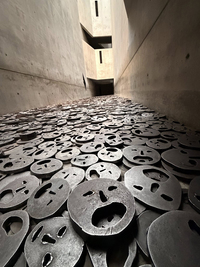
The group traveled May 19-28 to Berlin, Warsaw, Krakow and Vienna, with stops that included the Jewish Museum in Berlin and the Auschwitz and Birkenau concentration camps in Poland.
“Our group got to go back in time and visit the places where the Holocaust took place,” said Nick Plesko, a Monmouth student from Streator. “Seeing the Holocaust was very surreal for me. Often, I found the horror that took place in these locations unimaginable to even comprehend.”
The trip was led by Ryan Colclasure, a Galesburg native and Monmouth College psychology professor, and faculty colleague Joan Wertz. Colclasure said the trip was designed to help students better understand “the psychological perspective of what sorts of social and political factors led to the dehumanization.”
Before traveling, students read Night by Elie Wiesel and Maus: A Survivor’s Tale by Art Spiegelman. The readings introduced students to survivor testimony and Holocaust history, but Colclasure said they did not fully prepare the group for what they saw in person.
“I thought I knew a lot, but to actually be there and see the suffering — it was a really hard day,” he said.
Colclasure said the prisoners who lived were subjected to “unimaginable horror.”
“Cruelty was the purpose,” he said. “They wanted to keep them as filthy, as dehumanized as possible. The dark psychology of the Nazis was truly incredible from a psychological perspective. Our students are thinking about where the echoes of that history are now in today’s world.”
Wertz said this was the third time the college’s program has taken students on a trip focused on World War II and the Holocaust.
“This is the third time our program has done this trip based on World War II and the Holocaust, because it’s such an important and educational experience,” she said. “I was particularly impressed with our students’ reflections following the day we spent at the Auschwitz and Birkenau concentration camps.”
The students also learned about World War II history more broadly, including the rise of the Third Reich and the destruction of Warsaw, which Colclasure said was 85 percent leveled during the war.
Ruby Dickerson, a Monmouth student from Galena, said visiting the sites in person gave her a deeper understanding of the Holocaust’s scale and impact.
“Seeing Auschwitz in person was meaningful because I grew up reading many Holocaust survivor testimonies and reflections,” Dickerson said. “Visiting a concentration camp and traveling throughout eastern Europe made me realize how much of a broad span the Nazis covered and how detrimental the damage was to the Jewish population. You can read about it, but seeing everything in person was life changing. This was an unforgettable trip.”