District officials say nearly 90 percent of construction spending went toward classrooms and educational spaces
New turf fields, scoreboards and planned athletic upgrades have become some of the most visible construction projects in Galesburg schools in recent years.
District officials say those projects represent the final stage of a decade-long construction plan in which nearly 90 percent of spending went toward classrooms and educational spaces.
GCUSD 205 spent $137.5 million on construction between 2015 and 2025. Of that, $121.4 million — about 88 percent — went toward school buildings and educational spaces. Athletic facilities and a warehouse used for district storage and maintenance operations accounted for $16.1 million, or about 12 percent, according to district financial records.
Superintendent Dr. John Asplund and Jennifer Hamm, assistant superintendent of finance and operations, recently sat down with Galesburg Community News to explain how the district has prioritized facility spending, how projects are funded and why athletics projects have become more visible in recent years.
“We’ve committed lots and lots of resources to every other part of the district before we did athletics,” Asplund said. “It’s just now we’re at the end of it.”
A decade-long facilities plan
The district’s construction push began in 2017, when Asplund arrived and held 13 community meetings asking residents what they wanted from their schools. Those conversations led to a long-range facilities plan that moved into full construction in 2019.
The overhaul included reorganizing grade levels, closing older buildings and renovating those that remained. The district shifted from K-5 to K-4 elementary buildings, closed one middle school and moved junior high students to the Galesburg Junior Senior High School campus to create a unified 7-12 configuration.
The work also included a new vocational center, redesigned preschool spaces, updated band and choir rooms, renovated auditoriums at Lombard Middle School and Galesburg Junior Senior High School, and life-skills labs at every grade level. Elementary students receive five elective courses each week: PE, STEM, art, music and library.
“Our fine arts spaces are among the best you’ll ever find,” Asplund said.
Four elementary buildings — Gale, Nielsen, King and Steele — were built in 1967 and 1968 and, according to Hamm, went largely untouched for nearly five decades. When she joined the district in 2015, none of the classrooms in those buildings had interior doors, a remnant of the open-concept school design popular at the time.
Why athletics spending is more visible now
Athletic facility investments in recent years include a new wrestling room and indoor training facility for soccer, baseball and softball; an expanded weight room; resurfaced baseball and softball diamonds; and a warehouse replacing an aging district storage facility.
The baseball and softball turf project was not originally envisioned as a full replacement. Asplund said the district initially intended only to address drainage problems at the baseball diamond, where an underground water source beneath that part of town causes recurring sinkholes.
When crews priced the excavation and regrading work, the additional cost to install artificial turf was roughly $80,000.
“I was completely against turfing,” Asplund said. “But then as we started looking at it, it didn’t seem wasteful because we had to do the work anyway.”
Investigation of the softball field revealed it had been laid over old asphalt chunks, preventing drainage and contributing to ongoing maintenance problems. The district ultimately rebuilt both fields.
Athletics spending in context
In the 2024-25 school year, the district spent $1.14 million on athletics — about 2.5 percent of the Education Fund’s $46.2 million in total expenditures. Instructional and support services accounted for the remaining $45 million, or 97.5 percent.
The district fielded 953 student-athletes last year. Gate revenue from athletic events totaled $66,347 — a figure Asplund and Hamm acknowledged is low by design. District students attend all events free of charge. Adults pay $5 per event, while children and senior citizens pay $3. Season passes range from $50 for junior high sports to $125 for a gold pass covering all grades 7-12 athletic events.
“It doesn’t come close to covering the cost of just football pads,” Asplund said of the gate revenue.
The district also shares half of football gate revenue with its marching band — a practice Asplund said he has not seen in other districts. The band program itself charges students nothing, including providing instruments to students who need them.
How projects are funded
The primary funding source for facility projects is a 1-cent sales tax approved by Knox County voters in 2010. The tax is countywide, with proceeds distributed to all school districts enrolling students in the county.
After Illinois changed its rules for online and marketplace sales in 2021, the district’s share of the countywide sales tax grew to about $300,000 a month.
The funds are restricted to permanent facility improvements, meaning movable items such as lunch tables or rolling equipment do not qualify.
Of the monthly receipts, $1.6 million annually is already pledged to retire bonds issued in 2014 for construction of Silas Willard Elementary School, the football stadium and field house. That obligation runs through 2037.
District officials said future maintenance projects may include borrowing against future sales tax revenue in order to complete projects sooner and avoid rising construction costs.
“The sooner we feel we can get that work done, the less expensive it will be for the taxpayer ultimately,” Asplund said.
Maintenance and future projects
The district has entered the first year of a five-year maintenance plan.
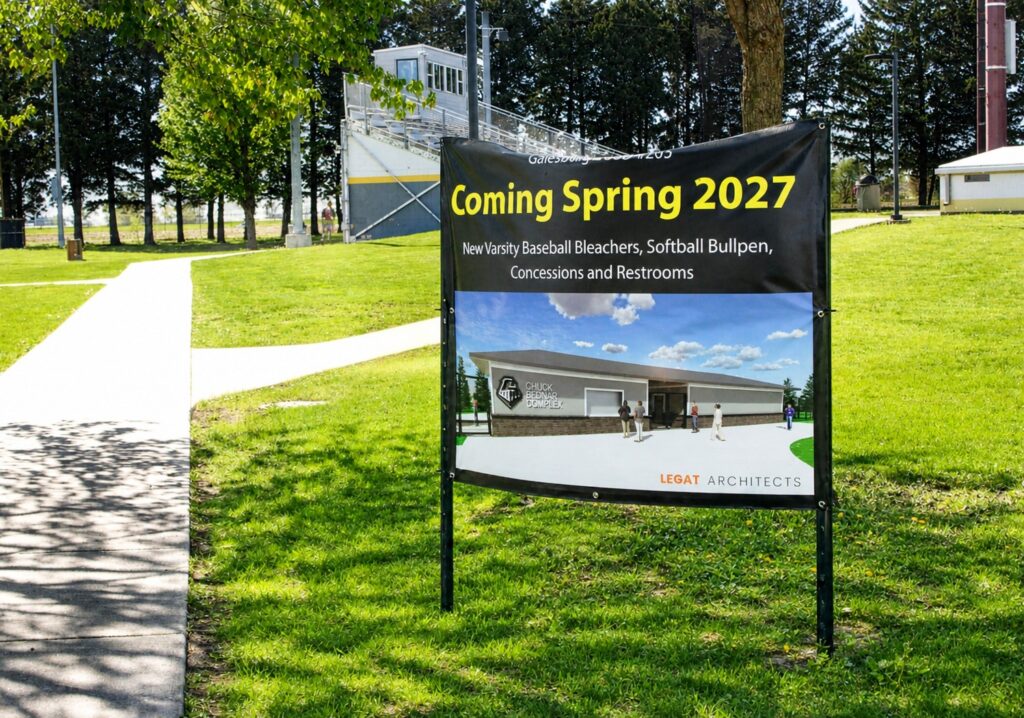
Upcoming projects include resurfacing the student parking lot at Galesburg High School, repainting and refinishing the floor at Field Gym, replacing bleachers at the Chuck Bednar Complex, and installing new scoreboards at the football stadium and old gymnasium.
The football field’s artificial turf — now in its 12th year on an expected 10-year lifespan — is scheduled for replacement as early as summer 2028.
The district also plans to extend electronic access control systems to Lombard Middle School and three elementary schools not yet equipped with the technology. The systems log building entry and exit and can lock down facilities automatically during emergencies.
Each installation costs approximately $250,000.
Additional projects include new flooring at Silas Willard and Steele schools and an expanded parking lot at Lombard to ease traffic during drop-off and pickup.
“We’re not talking about adding square footage,” Asplund said. “It’s just maintaining buildings, flooring, walls, things like that.”
Affordability and student access
Asplund and Hamm also pointed to programs and policies they said help reduce financial barriers for students and families.
There are no participation fees for athletics, no registration or enrollment fees and no costs for the band program. Every student receives free breakfast and lunch through the federal Community Eligibility Provision.
Driver’s education and a $25 annual parking pass are the only charges a student can incur from kindergarten through graduation, Hamm said.
“We try to make things as affordable for our families as possible so that students can participate in as much as possible,” Hamm said.
Hamm said the district also offers a wider range of electives than many comparable schools, including five weekly elective periods for elementary students and a fifth-grade band program.
A former Galesburg band director who moved to Morton found that district charges families hundreds of dollars annually for band participation, Asplund said.
“Here it’s literally zero dollars,” he said.